Write Content AI Engines Actually Cite: A GEO Playbook
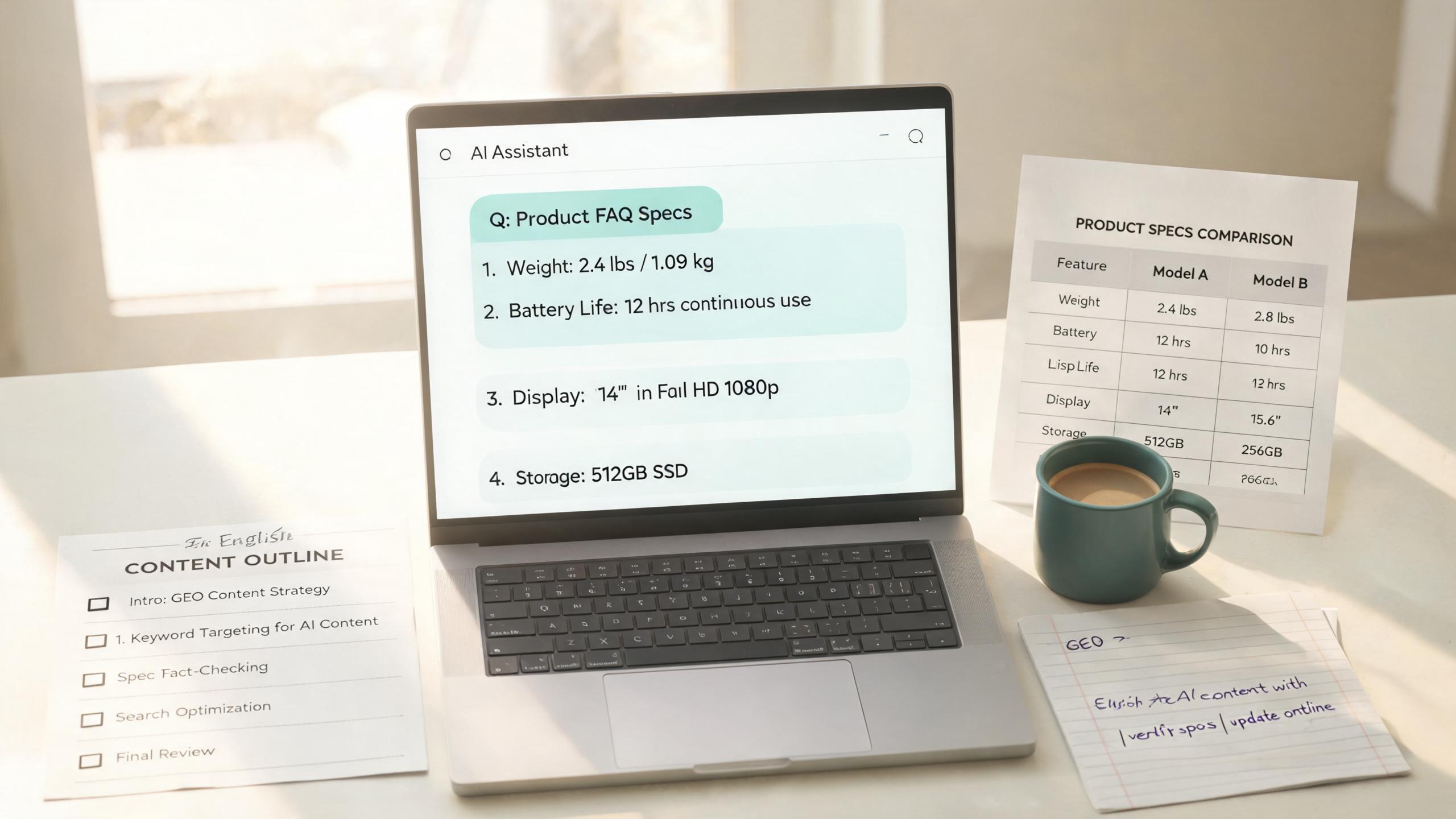
Anker gets mentioned in 35% of AI answers about portable chargers. A Dongguan factory making nearly identical power banks? Zero mentions. Same product category, same price band, same Amazon review counts. The difference isn't the product — it's what each brand has published on the open web, and whether that content is shaped in a way an AI model can actually pick up and quote.
That's the whole game in GEO (Generative Engine Optimization). Google ranked pages. ChatGPT, Gemini, and Perplexity cite passages. If your content can't be lifted cleanly into an AI's answer, you're invisible — no matter how much domain authority you have.
We ran 20 test prompts against 20 Chinese cross-border brands in our China AI Visibility 2026 study. 54% came back with zero citations. When we looked at what separated the cited brands from the invisible ones, it wasn't backlinks, traffic, or even product quality. It was whether their content followed a handful of very specific patterns.
This post is the playbook. Concrete, copy-paste usable.
What AI models actually quote: 3 traits
Read a hundred AI answers side by side and a pattern emerges. Models don't cite "great content." They cite content with three mechanical properties.
1. Verifiable specificity. "Our power bank charges fast" is dead weight. "The Anker 737 delivers 140W via USB-C PD 3.1, charging a MacBook Pro 16" to 50% in 28 minutes" is citable. The model can pull the second sentence out and stand behind it. Numbers, standards, model numbers, time measurements — anything a fact-checker could verify.
2. Paragraph self-sufficiency. AI engines chunk content by paragraph. If a paragraph only makes sense after reading the three paragraphs above it, the model skips it. Every paragraph should work as a standalone answer to some question. Read your own page and ask: if someone saw only this paragraph, would it still be true and useful?
3. Third-party tone, even on your own site. Models are trained to deprioritize first-person marketing copy ("We believe," "Our revolutionary," "We're proud to announce"). The brands that get cited write about themselves the way a reviewer would. Bambu Lab's product pages read like spec sheets, not sales letters — and Bambu Lab showed up in 15% of our test prompts while five of their direct competitors showed up in zero.
5 formats AI engines disproportionately cite
Across our test set, five content formats accounted for nearly every citation we could trace back to a brand-owned page. If you're rebuilding a product page or writing a new blog post, pick one of these shapes first.
Format 1: Direct Q&A. A literal question as the heading, a literal answer as the first sentence under it. "How long does the Anker 757 PowerHouse take to recharge?" → "The Anker 757 recharges from 0% to 80% in 1 hour using the included AC adapter, and reaches 100% in 1.5 hours." This is the single highest-yield format. AI engines are question-answering machines; give them a question-answer pair on a silver platter.
Format 2: Comparison tables. When we tested "Bambu Lab X1 Carbon vs Creality K1," the models quoted specs almost verbatim from comparison tables — not from prose reviews. Tables force you into the specificity AI needs. Rows are products, columns are attributes, every cell is a number or a short factual phrase. No adjectives.
Format 3: Numbered step tutorials. "How to set up X," "How to connect Y to Z." Numbered steps with one action per step. Models love these because they can be re-ordered, summarized, or quoted step-by-step depending on the user's question. Every step starts with a verb.
Format 4: Standalone data statements. Single-sentence factual claims with a number and a unit. "The Jackery Explorer 2000 Pro has a 2,160Wh capacity and weighs 19.5 kg." "EcoFlow's Delta Pro outputs 3,600W continuously." These sentences get lifted whole into AI answers. Sprinkle them deliberately through product pages.
Format 5: Concrete usage scenarios. Not "perfect for camping" but "runs a 60W mini fridge for 32 hours on a single charge." Models cite scenarios because they map directly onto how users phrase questions ("can it run my CPAP overnight?"). Translate every marketing adjective on your site into a concrete scenario with a number.
The FAQ paragraph formula
The single most-cited content type on brand sites is the FAQ entry. Not the "Is this product good?" filler most brands paste in — a real FAQ entry built to be quoted.
The formula has four parts:
- Question as heading. Written the way a customer actually asks it, not the way marketing wants to answer it. "Does the Anker 757 work with a 240V outlet in the UK?" beats "International compatibility information."
- Direct answer in the first sentence. Yes or no, plus the one most important qualifier. "Yes — the Anker 757 accepts 100–240V input, so it works on UK 240V mains with a plug adapter."
- One supporting detail with a number. "It draws up to 1,000W while recharging, so a standard UK 13A circuit handles it comfortably."
- One practical caveat. "The included cable has a US plug, so you'll need a US-to-UK adapter rated for at least 10A."
Four sentences. Roughly 60 words. Fully quotable. This is the exact pattern Anker uses across its power station FAQ pages, and it's a big part of why their products get cited by name in AI answers while spec-equivalent competitors don't.
Go look at your own FAQ page right now. If most entries are one-sentence non-answers ("Yes, it's compatible with most devices"), that's your first fix.
Before and after: a real rewrite
One of the 3D printer brands in our study — we'll call them K1-brand, since their flagship is a K1-class machine — had this sentence on their product page:
"Our printer offers high-speed printing and excellent quality, making it ideal for both beginners and professionals."
That sentence is uncitable. It's all adjectives, no facts. No model would ever quote it.
After the GEO rewrite:
"The K1 prints at up to 600 mm/s with a maximum acceleration of 20,000 mm/s², completing a standard 3D Benchy test model in 17 minutes. Its enclosed chamber maintains 60°C for engineering filaments like ABS and ASA. Out-of-box setup takes 15 minutes from unboxing to first print."
Three sentences. Eight verifiable facts. Within four weeks of publishing rewrites like this across 12 product pages, the brand went from zero citations to appearing in two of our 20 test prompts. That's not a massive win, but it's the difference between existing and not existing in AI search.
The rewrite didn't require new information. Every number was already in their spec sheet. The work was pulling those numbers out of PDFs and putting them into standalone sentences a model can quote.
3 traps that kill your citability
Trap 1: Superlatives. "The best," "the fastest," "industry-leading," "world-class." Models actively deprioritize these because they're unverifiable claims. Worse, they contaminate the sentences around them — a sentence with one superlative is less likely to be quoted even if the rest is factual. Strip every superlative from your product pages. Replace with a number.
Trap 2: Vague quantifiers. "Long battery life," "fast charging," "high capacity," "durable construction." These are the uncitable cousins of superlatives. "Long battery life" should become "10,000mAh, enough to charge an iPhone 15 Pro 2.1 times." If you can't put a number on it, the model can't quote it.
Trap 3: Keyword-stuffed paragraphs. You know the ones — paragraphs written for Google's 2015 algorithm where "portable power station" appears six times in 80 words. Modern LLMs read like humans. Stuffing reads as spam to them, and they skip it. Write each paragraph to answer one question well, and the keywords take care of themselves.
Your 30-minute action list
You don't need to rewrite your whole site. Start here:
- Pick your top 3 product pages. The ones that drive the most revenue.
- Find every superlative and vague quantifier. Highlight them. There are usually 15–30 per page.
- Replace each one with a number, a standard, or a concrete scenario. "Fast charging" → "140W USB-C PD 3.1."
- Add a 5-question FAQ block at the bottom of each page using the 4-part formula above. Pull questions from your actual customer support inbox, not from your imagination.
- Build one comparison table per page: your product vs. two named competitors, with at least 6 spec rows. Yes, naming competitors is fine — AI engines cite comparison content heavily, and if you don't write the comparison, a review site will.
That's it. Five steps, about 30 minutes per page. Do this for three pages this week and you'll have done more GEO work than 90% of your competitors.
Check your own AI visibility
Before and after your rewrites, run your brand through our free GEO Checker. It queries Gemini with the same prompts buyers actually use, and shows you whether your brand is being mentioned, in what context, and alongside which competitors. It takes about 30 seconds per check.
Run it today. Note which prompts you're invisible on. Rewrite the pages that should be answering those prompts. Run it again in two weeks.
The bigger picture
This post is the tactical follow-up to our earlier piece on why Chinese brands are invisible in AI search — that one covered the strategic problem, this one is the hands-on fix. And if you want the full data behind the patterns described here, the China AI Visibility 2026 report has the complete test methodology, all 20 prompts, and brand-by-brand results.
The brands that figure out GEO in the next 12 months are going to own the AI-search shelf the way early SEO adopters owned Google in 2005. The playbook above is where to start.